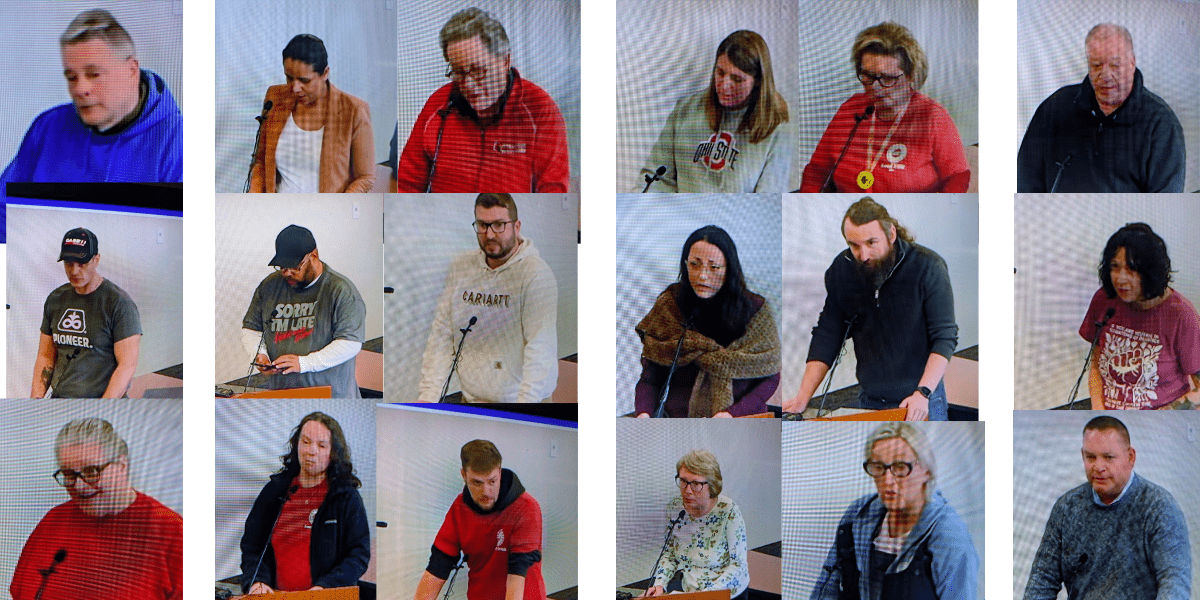
ELYRIA — A packed Lorain County Board of Commissioners meeting Tuesday, Feb. 24 drew more than a dozen speakers during public participation, many of them connected to the ongoing strike at Lorain County Job and Family Services. Other residents used the microphone to raise concerns about sewer planning, the county’s proposed mega site, public records access and broader confidence in county leadership.

The meeting, held at the Lorain County Administration Building, included agenda-related comment and general public participation. Several speakers referenced the Job and Family Services strike involving members of UAW Local 2192, while others questioned the county’s direction on large infrastructure planning and what they described as unanswered requests for documentation.
JFS strike takes center stage during public participation
Workers and supporters challenge public statements about the contract
Several speakers identified themselves as Job and Family Services employees, bargaining representatives or supporters and disputed public statements they said county leadership has made about negotiations.
Sandra Jensen of Sheffield Lake said she has worked at Job and Family Services for about 10 years and currently earns $17.77 per hour in Adult Protective Services intake. Jensen said wages and health care costs have become a breaking point for workers and urged commissioners to personally return to the bargaining table. She cited her experience as a school board member, saying elected officials sometimes need to step in directly to resolve contract disputes.
Nadine Plavsich of Lorain said Job and Family Services employees have been without a contract since September. She said unfair labor practice charges have been filed and urged commissioners to return to negotiations.
Otis Lovejoy of Elyria read a prepared statement on behalf of a Job and Family Services worker who did not feel comfortable speaking publicly. Lovejoy disputed messaging that he said mischaracterized what employees are asking for, and he urged commissioners to meet with workers to resolve the contract.
Candice, who said she works at Job and Family Services but did not provide an address, said she loves her job but could make more elsewhere. She said her wages are low enough that her child qualifies for Medicaid and shared a message she said came from a client thanking her for help navigating long-term care decisions.
Speakers describe wages, benefits and retention concerns
Tyler Brickman of Vermilion said he serves on the bargaining committee and accused the county of misrepresenting union demands. Brickman specifically disputed claims that workers were seeking a $5,000 bonus, a 26% wage increase or broad work-from-home privileges, saying those descriptions were inaccurate. He said the county’s “last, best, final” offer did not materially change from earlier proposals.
Shawna Hatfield of LaGrange said workers are leaving public service because they can earn more in the private sector. She pointed to a job posting she said offered a starting wage higher than what some current employees make and urged commissioners to return to bargaining.
Sarah Noonan of Grafton spoke in support of UAW Local 2192 and framed the dispute as a livable wage and health care affordability issue. She urged commissioners to spend time observing the work performed by Job and Family Services employees.
Graig Bansek of Elyria, who identified himself as a school superintendent, urged commissioners to resolve the dispute. He said prolonged labor conflicts damage trust and morale and argued that negotiations should not go long periods without direct talks.
Sewer planning and mega site concerns focus on cost and transparency
Residents question project direction and potential impacts

Several residents focused their comments on sewer planning and the county’s proposed mega site, questioning decision-making, project scale and how support for the project is being described.
William Zimmerman of Avon Lake spoke during agenda-related comment and again during public participation. Zimmerman questioned the county’s direction on sewer planning, raised concerns about public trust and also questioned potential conflicts of interest, including land ownership and campaign contributions.
Chad Arcaba of South Amherst spoke from the perspective of a multigenerational farm family and said the sewer project threatens agricultural land and rural communities. He said rural residents feel dismissed and urged commissioners to reconsider the direction of the project.
Kevin Machovina of South Amherst questioned the need for sewer expansion in areas with functioning septic systems. He argued that infrastructure investment should focus on redevelopment in existing communities rather than rural townships and challenged the rationale being offered for the scale of the project.
Andrea Barlow of New Russia Township said residents are frustrated by what they see as escalating spending tied to a project they do not support. She cited specific dollar figures she said have been discussed publicly for financing, site identification and engineering work and urged commissioners to end what she described as backroom decision-making.
Speakers request records and verification of project support
Kim Polen of Lorain County challenged the county’s repeated references to “key stakeholders” supporting the mega site and asked commissioners to provide documentation showing which entities have formally endorsed the project. Polen referenced a petition opposing the project that she said includes thousands of local signatures. She also described what she said have been repeated difficulties obtaining records through public records requests, including requests being routed to the prosecutor’s office and ending without documents being produced.
Brian Baker of Amherst referenced prior commissioners meetings and statements by local officials, saying he believes the record shows uncertainty about which communities have committed to the project. He also questioned statements about funding provided to Brownhelm Township for land-use planning and asked commissioners to clarify the source of the money.
Karen Johnson, who provided a Grafton-area address, delivered a detailed list of public records requests related to mega site planning and sewer financing. Her requests included materials submitted for state funding, letters of support referenced in applications, agreements involving private landowners and records tied to recent bond and engineering actions. During the exchange, a commissioner asked Johnson to provide the list to county staff before leaving.
Other speakers raise personal cases and broader confidence concerns
Nicole Amill, who said she lives in Lorain County, described concerns related to her domestic relations case and questioned how enforcement actions are being handled. She asked commissioners to ensure proper oversight of court-related processes.
Jim K. of Oberlin listed a series of county controversies he said have appeared repeatedly in recent months and questioned how the county can pursue large infrastructure projects while addressing operational and service pressures.
Across the comment period, speakers repeatedly urged commissioners to address unresolved issues directly, return to negotiations where disputes exist and provide clearer documentation and communication to the public.
Many of the issues raised during public participation remain unresolved and ongoing, with multiple speakers urging action on labor negotiations, sewer planning and public records requests. Those topics are expected to continue surfacing in upcoming commissioners meetings.
Public participation followed the board’s standard format, with speakers addressing the chair and commissioners not engaging in dialogue during comments. Before the board unanimously voted to enter executive session, Commissioner Dave Moore said, “You can tell who’s running and who’s not running for office,” then chuckled. After executive session, the meeting was concluded.
Watch the full meeting