Cuts, new revenue reshape outlook

AMHERST — Amherst Schools August financial forecast is considerably more favorable than the district’s February projection, but officials say the outlook relies heavily on voters approving a 5.97-mill property tax levy in November.
Treasurer Amelia Gioffredo presented the updated forecast during the Aug. 10 Board of Education meeting.
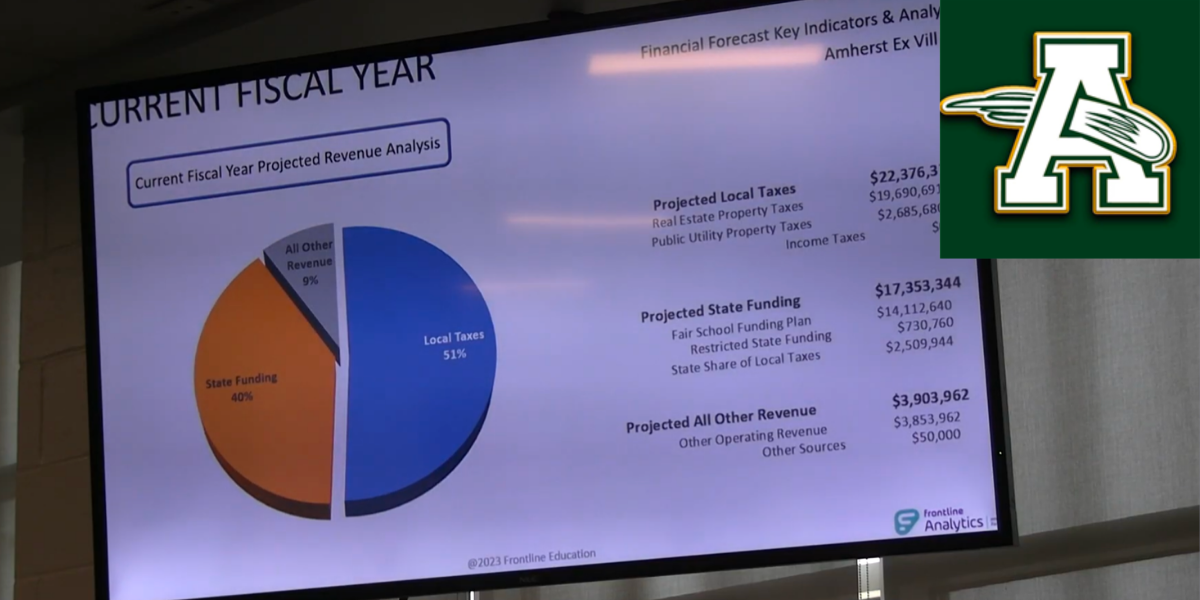
For fiscal 2027, the district expects about $43.6 million in general fund revenue and $44.27 million in spending, with projected deficit spending of about $645,000.
That deficit is about $3.4 million smaller than in fiscal 2026, Gioffredo said.
The improvement comes as the district implements a state-required plan calling for more than $13.26 million in spending reductions between fiscal 2026 and fiscal 2029.
Gioffredo said the district expects about $3.6 million in reductions during fiscal 2027, $4.9 million in fiscal 2028 and $4.8 million in fiscal 2029.
Levy remains key
The improved forecast carries an important assumption: passage of the district’s proposed 5.97-mill fixed-rate property tax levy in the Nov. 3 general election.
Gioffredo told the board that much of the forecast’s financial health depends on passage of the levy.
One mill equals $1 for each $1,000 of taxable value. Amherst Schools estimates the proposed levy would cost $209 annually for each $100,000 of county auditor market value.
The levy is expected to generate about $5.8 million annually for day-to-day district operations. (Amherst Exempted Village Schools)
The forecast also assumes continued collection of the district’s existing 4.9-mill operating levy. That levy was first approved in 2012, most recently renewed in May 2022 and must be renewed again before the end of 2027. (Thrillshare)
Gioffredo cautioned during the meeting that financial forecasts depend on assumptions that can change because of economic conditions, fuel and utility costs, state funding and other factors outside the district’s control.
A board member also asked whether passage of the new levy would directly reduce the district’s state funding.
Gioffredo said it would not.

She said state funding is affected in part by local assessed property values and residents’ income. As those measures increase compared with statewide averages, the district can receive a smaller share of state funding.
Cuts already taking effect
The district’s financial problems previously resulted in intervention from the Ohio Department of Education and Workforce.
ODEW reviewed Amherst’s October 2025 forecast and identified a projected $7.45 million deficit in fiscal 2028. The district was placed in precautionary financial status and required to develop a written plan to eliminate the projected deficit. (Thrillshare)
That plan calls for $13,264,733 in spending reductions through fiscal 2029. (Amherst Exempted Village Schools)
Some savings began during fiscal 2026 when positions that became vacant through retirements or resignations were not filled.
Gioffredo said much of the savings in the current forecast can be seen in salaries, retirement and other employee benefits, along with supplies and materials.
TIF brings new revenue
Another major improvement came from revenue tied to a tax increment financing agreement with the city of Amherst.
Tax increment financing, commonly called TIF, uses revenue connected to growth in property values to help finance public improvements.
The Amherst Board of Education approved a TIF exemption and school compensation agreement with the city in 2021. (Cloudinary)
Gioffredo said the agreement began producing revenue for the district this year, totaling about $1.7 million annually.
Nearly $860,000 reached the district’s general fund in revenue that had not been included in earlier projections.
Overall, Amherst now expects about $2.1 million more fiscal 2027 revenue than it projected in February, with much of the improvement coming from the TIF.
The district also expects salary and benefit costs to be about $747,000 below the February forecast, while purchased services are projected to be about $400,000 higher.
Despite the improved near-term outlook, Gioffredo said expenditures are projected to again exceed revenues later in the forecast period, drawing down the district’s cash reserves.
Related posts:

 Ohio Senate Bill 50 would let 14 and 15 year olds work later during the school year
 Larkmoor Elementary Placed on Temporary Lockdown Monday
 North Ridgeville Students Beat 3,600 Entries to Win Regional Stop the Hate Contest