Excused time triggers earlier family notices

COLUMBUS — Ohio schools must now contact families earlier about missed instructional time, including absences supported by medical documentation, under attendance changes taking effect for the 2026-27 school year.
Medically excused absences remain excused and do not count toward truancy. However, they are included when determining whether a student is chronically absent and when a school must notify the student’s family.
The changes were included in House Bill 96, Ohio’s 2025-27 state operating budget. The attendance provisions originated in Gov. Mike DeWine’s executive budget proposal and remained in the spending plan approved by the General Assembly.
The law took effect Sept. 30, 2025, but school boards had until Aug. 1 to adopt updated attendance policies.
Under the law, a student is chronically absent after missing at least 10% of the minimum instructional hours required for the school year. The calculation includes excused, medically excused and unexcused absences.
Districts must establish a threshold for notifying families about attendance concerns. That threshold cannot exceed 5% of the state’s minimum instructional hours.
For students in all-day kindergarten through sixth grade, notification must occur no later than 45.5 missed hours. For students in seventh through 12th grade, the threshold is no more than 50.05 hours. Half-day kindergarten students must be reported by 22.75 missed hours.
Depending on the length of the school day, the threshold generally represents about 7½ to 8½ missed days for full-day students. Districts may choose to contact families sooner.
The previous law required written notification when a student accumulated 38 hours of nonmedical excused or unexcused absences in one school month or 65 hours during a school year. Medically excused absences were excluded from those notification thresholds.
Ohio was already including excused, medically excused and unexcused absences when calculating chronic absenteeism for state report cards. The new law places the definition into state statute and connects it with local notification and intervention requirements.

For families managing chronic or terminal illness, the change means a student can cross the chronic-absence threshold even when each absence is medically necessary and properly documented.
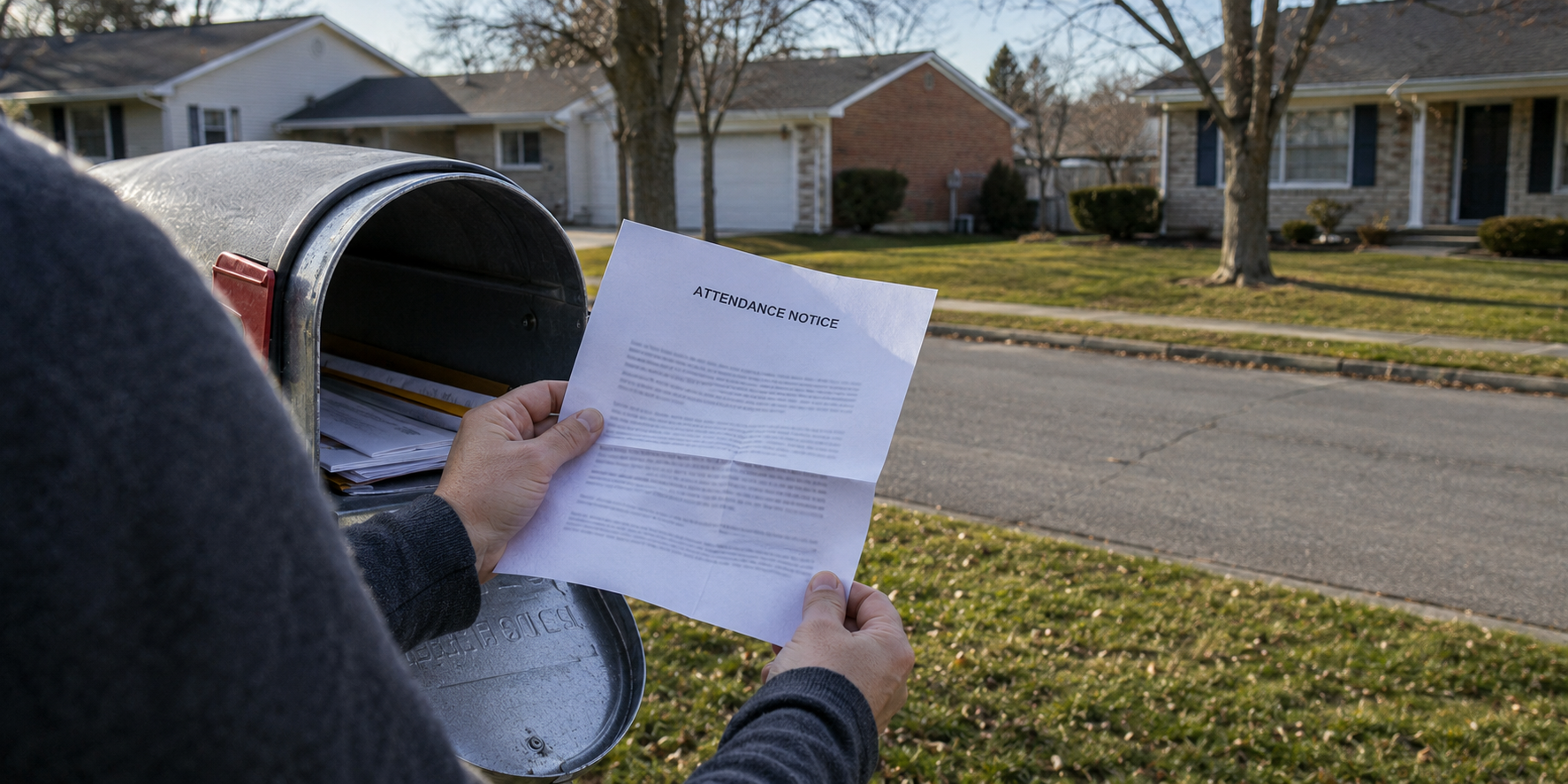
That means a family caring for a chronically ill child could receive a district letter identifying the child as chronically absent. Because districts determine the wording of those notices, the letter also could describe potential legal action associated with truancy.
However, medically excused absences alone cannot trigger truancy proceedings. Legal action is possible only if the student separately reaches one of the unexcused-absence thresholds and the student and family are not making satisfactory progress toward improving attendance.
The Ohio Department of Education and Workforce says schools can work with families and medical teams to develop individualized responses for students dealing with acute or chronic physical or mental health conditions. Local policies determine what documentation is required and how the school responds.
State law does not require a doctor’s note for every medical absence. Documentation may include a note from a medical professional, a record of a conversation with a parent or another process established by the district.
The chronic-absence designation does not automatically result in a court filing or truancy charge.
Habitual truancy continues to be based only on unexcused absences. A student is considered habitually truant after accumulating 30 consecutive unexcused hours, 42 unexcused hours in one school month or 72 unexcused hours during a school year.
Even after one of those thresholds is reached, a court complaint is not required if the school determines the student and family are making satisfactory progress toward improving attendance.
District policies must also establish tiered interventions intended to address the causes of missed school and provide absence-intervention teams for students at risk of becoming chronically absent. Schools may not suspend, expel or otherwise prevent a student from attending because of absences.
Because districts determine their notification procedures and intervention systems within the state requirements, the content of attendance letters and the response to medically documented absences may vary by school system.
Related posts:

 Ohio Senate Bill 50 would let 14 and 15 year olds work later during the school year
 Larkmoor Elementary Placed on Temporary Lockdown Monday
 North Ridgeville Students Beat 3,600 Entries to Win Regional Stop the Hate Contest